
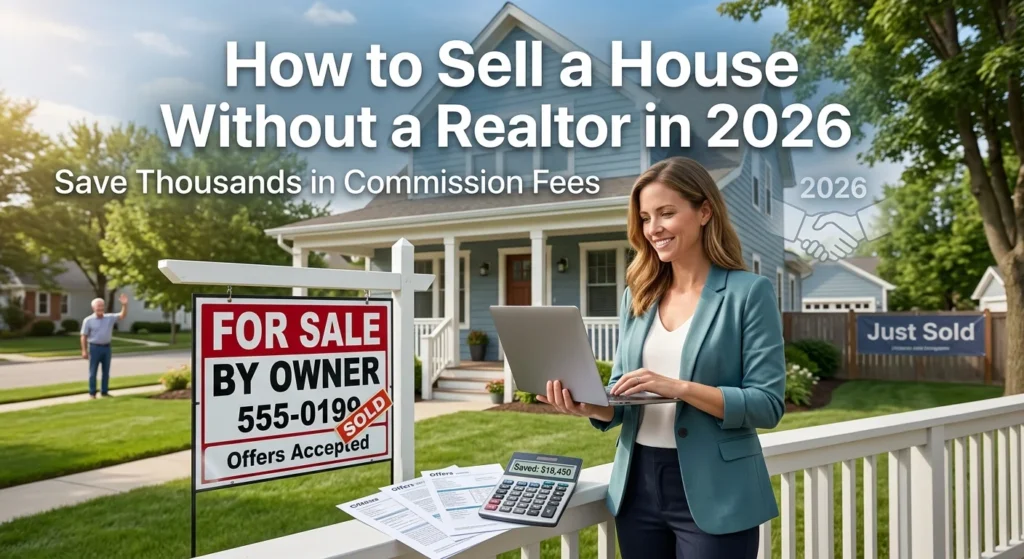
Removing a listing agent from a home sale puts $10,000 to $12,000 back into the seller’s pocket on a $400,000 property. That figure equals the standard listing commission of 2.5% to 3% of the final sale price. In a For Sale By Owner transaction, every dollar of that commission stays with the seller at closing.
According to the 2026 National Association of Realtors, FSBO transactions account for just 5% of all US residential home sales. That low share reflects the workload, not a legal restriction. Selling a house without a realtor is fully legal in all 50 states. Sellers who succeed in FSBO transactions prepare before listing, not after..
Selling a House Without a Realtor
A For Sale By Owner transaction, abbreviated as FSBO, is a home sale in which the owner manages pricing, marketing, disclosures, negotiations, and closing without hiring a licensed listing agent. Every task that agent would otherwise handle transfers entirely to the seller.
Sellers entering FSBO with a buyer already lined up, or those listing in a low-inventory market with active buyer demand, carry the lightest workload. Sellers starting with no identified buyers in a balanced or buyer-favoring market take on considerably more.
How Much You Save Without a Listing Agent
Skipping the listing agent removes the listing agent commission from the closing settlement entirely. Standard listing commissions in the United States run 2.5% to 3% of the final sale price. On a $400,000 home, that amounts to $10,000 to $12,000 retained by the seller.
The buyer’s agent commission stays as a separate negotiation. Most FSBO sellers offer 2% to 2.5% to attract buyers working with representation. That portion still gets paid at closing, but the seller’s own commission disappears from the transaction.
NAR’s 2026 data puts the median FSBO sale price at $360,000, against $425,000 for agent-assisted sales. That $65,000 gap traces back to sellers accepting below-market offers from experienced buyer’s agents. A verified Comparative Market Analysis and a legally reviewed purchase contract close most of that gap before any offer reaches the negotiating table.
How to Sell Your House Without a Realtor
Below are 7 structured steps to complete a private home sale in the United States, from setting the right price to handing over the keys
- Research Your Home’s Value Before Setting a Price
Pricing starts with a Comparative Market Analysis, or CMA. A CMA compares the subject property against 3 to 5 homes that closed in the same zip code within the past 90 days, matching on square footage, bedroom count, condition, and lot size. That comparison produces a defensible listing price range based on actual closed transactions. Free CMA tools are available on Zillow and Redfin. Local title companies and real estate attorneys often prepare one at no cost. Listing 5% above the market-supported price range cuts showing requests by 30% to 40%, according to 2025 Redfin listing performance data. A mid-listing price reduction signals distress to buyers who were already watching. - Prepare the Property Before Any Photos Are Taken
Professional photography increases online listing views by 118% compared to seller-taken photos, based on Redfin’s 2024 listing performance study. Most US markets price a professional real estate photographer at $150 to $300. Deep cleaning, interior decluttering, and exterior curb appeal work before the photographer arrives deliver the highest return per dollar spent. Adding a virtual tour filters out buyers whose expectations do not match the actual property, keeping the showing schedule filled with serious, pre-qualified visitors rather than casual browsers. - Get the Listing on the MLS Through a Flat Fee Service
FSBO sellers reach the Multiple Listing Service through flat fee MLS providers. A one-time fee of $99 to $499 places the listing on the MLS and pushes it automatically to Zillow, Redfin, Trulia, and Realtor.com simultaneously. Ninety percent of active US buyers work with a buyer’s agent. Buyer’s agents search the MLS before any other platform. A FSBO listing absent from the MLS reaches fewer than 10% of buyers actively searching in that market on any given day. - Manage Showings and Buyer Inquiries
A dedicated phone number or email address for buyer contact, set up before the listing publishes, keeps showing requests separated from personal correspondence from the first day. Every confirmation, inquiry, and follow-up runs through that single channel. A sign-in sheet or digital check-in form at each showing records buyer contact details. Requesting mortgage pre-approval letters or cash proof of funds before scheduling any showing removes buyers who are browsing without serious purchase intent. That filter saves significant time across a 30 to 90 day listing period. - Review Offers and Negotiate Terms
Every written offer arrives on a standard purchase contract form. The 4 primary terms to evaluate in any offer are the offered price, financing type, attached contingencies, and the proposed closing date. Cash offers close in 14 to 21 days. Financed offers require 30 to 60 days after signing for mortgage underwriting, appraisal, and final lender clearance. Sellers receiving multiple offers should set a deadline for highest and best submissions rather than responding to each offer as it arrives. Attorney review of contract terms and contingency language costs $200 to $500 and catches problems before they become liabilities. - Complete the Required Legal Documents
Six documents are required in every standard US home sale. These are the Purchase and Sale Agreement, Seller’s Property Disclosure, Lead-Based Paint Disclosure, Preliminary Title Report, Bill of Sale, and IRS Form 1099-S. Federal law mandates the Lead-Based Paint Disclosure for all homes built before 1978, regardless of state. State-approved versions of every required document are available at no cost through each state’s real estate commission website. According to the NAR, 15% of real estate contracts hit settlement delays in January 2026 because of missing disclosure signatures or incomplete addenda. Sellers in Connecticut, Delaware, Georgia, Massachusetts, North Carolina, Rhode Island, South Carolina, and West Virginia must use a licensed real estate attorney for part or all of the closing process under state law. - Close the Sale With a Title Company or Attorney
A title company or real estate attorney manages closing in most US states. The title company runs a title search, issues title insurance, holds escrow funds, and distributes proceeds to all parties on the scheduled closing date. Seller closing costs on a FSBO transaction average 1% to 3% of the final sale price. On a $400,000 home, that totals $4,000 to $12,000. That range covers the title transfer fee, escrow fee, prorated property taxes, recording fees, and any outstanding HOA dues. No listing agent commission appears anywhere in that total.
What Paperwork Do You Need for a FSBO Sale
The Sale and Purchase Agreement sets every contractual term between buyer and seller. The Seller’s Property Disclosure informs the buyer of all known material defects. Inaccurate or incomplete disclosure forms expose the seller to post-closing civil liability regardless of agent involvement.
Federal law requires the Lead-Based Paint Disclosure for all homes built before 1978. The Preliminary Title Report confirms the seller holds a clear, lien-free title before the closing process begins. The Bill of Sale transfers ownership of any personal property included in the transaction. IRS Form 1099-S reports gross proceeds to the federal government and triggers capital gains tax obligations for the seller.
Some transactions require additional documentation beyond those six. HOA financial statements apply to properties in a homeowners association. Rural properties often require well and septic inspection reports. A buyer’s mortgage lender may request a current property survey before approving the loan.
Is FSBO Legal in Your State
Selling a house without a realtor is legal in all 50 US states. No state law requires a homeowner to hire a licensed real estate agent to sell a property held in their own name.
Eight states require licensed attorney involvement at specific stages of the closing process. Those states are Connecticut, Delaware, Georgia, Massachusetts, North Carolina, Rhode Island, South Carolina, and West Virginia. Outside those eight, a title company handles closing. Attorney review of the purchase contract, at $200 to $500, is a recommended step in any state even when not legally required.
FSBO sellers carry the same disclosure obligations as agent-represented sellers. Selling without a realtor does not reduce legal exposure for undisclosed known defects.
What Are the Real Risks of Selling FSBO
Underpricing produces the largest financial loss in FSBO transactions. NAR’s 2026 data shows a $65,000 median price gap between FSBO and agent-assisted sales. That gap closes through accurate CMA pricing and a willingness to counter low offers with market data rather than emotion.
Disclosure liability follows as the second major risk. Sellers who leave known structural damage, roof conditions, water intrusion history, or pest infestations off the disclosure form face civil lawsuits after closing. Contract errors rank third in frequency. Incomplete purchase agreements, missing addenda signatures, and improperly written contingency dates cause the types of settlement delays the NAR recorded in 15% of January 2026 contracts.
Negotiation inexperience rounds out the four primary risks. Buyer’s agents negotiate purchase contracts daily. On repair credits, closing cost contributions, and possession date adjustments, a skilled buyer’s agent extracts concessions from an unprepared FSBO seller during a single offer review session.
When Going FSBO Actually Works in Your Favor
FSBO produces the strongest financial result in 3 specific situations. First, a pre-identified buyer eliminates the marketing step entirely. Transactions with neighbors, family members, or workplace contacts often close faster than any MLS listing and sometimes skip the open market entirely.
Second, a strong seller’s market with limited inventory reduces the value of professional marketing. Low supply drives multiple offers to listings within days regardless of how the property is marketed. The professional representation advantage shrinks considerably in that environment.
Third, a direct cash sale to a home buying company removes the most time-consuming stages from the process altogether. The seller skips MLS listing, open houses, repair negotiations, and the mortgage contingency period. A written cash offer arrives in 24 to 48 hours. Closing completes in 14 to 21 days. Sellers under time pressure from a job relocation, financial difficulty, or a court-ordered sale deadline benefit most from this approach. Maxx Cash Home Buyers purchases homes directly for cash with no listing fees, no repairs, and no agent commission.
Frequently Asked Questions
How Long Does a FSBO Sale Take to Close
A FSBO sale takes 30 to 90 days from the listing date to closing in most US markets. Transactions with pre-identified buyers or cash home buyers close in 14 to 21 days. Financed buyer transactions require 30 to 60 days after contract execution for mortgage underwriting, appraisal review, and final lender approval.
Do You Need a Real Estate Attorney for a FSBO Sale
Sellers in Connecticut, Delaware, Georgia, Massachusetts, North Carolina, Rhode Island, South Carolina, and West Virginia are required under state law to use a licensed real estate attorney at closing. In all other states, attorney involvement is not mandatory but costs $200 to $500 for contract review and significantly reduces exposure to documentation errors and post-closing disputes.
Homeowners selling a property received through inheritance face additional probate requirements and deed transfer steps that go beyond a standard FSBO transaction. A complete breakdown is available in the guide on selling an inherited house.
What Is the Fastest Way to Sell a House Without a Realtor
A direct cash sale is the fastest available method. Cash buyers purchase properties in as-is condition with no MLS listing, no repairs, no open houses, and no mortgage contingency. Most companies provide a written offer within 24 hours and close within 14 days.
Sellers navigating a divorce who need to liquidate a jointly owned property under a legal deadline face a different set of requirements. That process is covered in the article on selling a house during a divorce.
Can a Seller Back Out of a Purchase Contract After Signing
A seller can exit a signed purchase agreement only under the specific contingency provisions written into that contract. Outside those provisions, withdrawing exposes the seller to breach of contract claims and potential forfeiture of the buyer’s earnest money deposit as damages. Any exit from a signed contract requires consultation with a real estate attorney before action is taken.
What Closing Costs Does a FSBO Seller Pay in 2026
FSBO sellers pay closing costs between 1% and 3% of the final sale price. On a $400,000 home, that equals $4,000 to $12,000 at closing. That range covers the title transfer fee, escrow fee, prorated property taxes, recording fees, and any outstanding HOA dues. No listing agent commission is included in that figure. Sellers who want to move a property quickly without completing repairs before listing have a separate option covered in the guide on how to sell a house fast without repairs.